

Paperless sterilisation centre
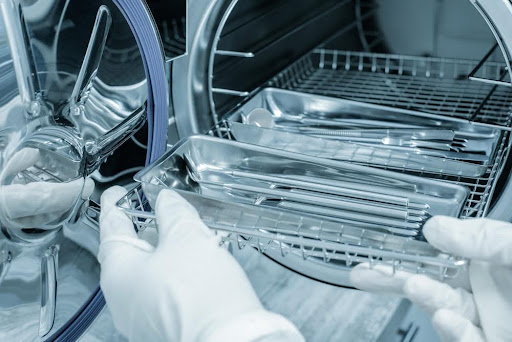
Artificial intelligence and automation for a smart and green sterilisation centre
Digital transformation is redefining the role of the sterilisation centre, making it increasingly strategic for clinical safety, risk management and operational efficiency. Errors in sterilisation processes can have a direct impact on patient safety, making increasingly precise and structured control essential.
A sterilisation centre is no longer simply the place where device sterility is ensured; it is a complex system that must be managed in a traceable, controlled and sustainable way. This evolution has given rise to the model of the digitalised and paperless sterilisation centre, where data, processes and technologies work together to improve overall performance.
In this context, Promedital supports sterilisation centres and healthcare facilities with solutions that combine digitalisation and artificial intelligence, helping to create a truly smart sterilisation centre capable of improving safety, efficiency and sustainability.
Digitalising the sterilisation centre: beyond paperless
The digitalisation of the sterilisation centre is the starting point, but it is no longer sufficient to view it simply as the elimination of paper records. The real transformation lies in the ability to convert operational data into structured, accessible and actionable information for effective process management.
In a digitalised sterilisation centre, every stage is recorded and made available in real time. More importantly, it becomes part of a wider ecosystem in which data communicates both internally and with other hospital systems. This provides greater transparency, enhanced control and a solid foundation for future developments. For healthcare organisations, this means improved process governance and reduced operational risk.
From this perspective, the sterilisation centre becomes a strategic information hub and a key element in building one of the connected sterilisation centres of the future.
A practical example of a digitalised sterilisation centre can be found at the CTO – Orthopaedic Trauma Centre of Turin, where the adoption of digital solutions improved system integration and process management, increasing traceability and control throughout the entire instrument workflow.
Artificial intelligence and automation: towards a smart sterilisation centre
While digitalisation provides the foundations, artificial intelligence enables a genuine step change. A smart sterilisation centre does not merely collect data; it is capable of interpreting and using it to continuously optimise processes.
AI applied to healthcare can, for example, identify recurring patterns, detect anomalies in sterilisation cycles, optimise workflows and support operational decision-making in real time. At the same time, automation reduces dependence on repetitive manual tasks, improving accuracy, standardisation and reliability.
In practical terms, a smart sterilisation centre enables organisations to:
- anticipate and prevent non-conformities;
- improve process quality and standardisation;
- support staff in operational decision-making;
- increase control and visibility across workflows.
Promedital technologies such as SUIS for automatic instrument recognition and EVA for surgical set verification provide a practical example of this approach. They do not replace operators; they support them, increasing levels of control while reducing the risk of error. In this way, the sterilisation centre evolves into a smart sterilisation centre that not only performs tasks efficiently but also continuously improves its own performance.
A further example in a complex operational environment is provided by Servizi Ospedalieri S.p.A., where the integration of digitalisation and automation enabled the organisation to optimise workflows and enhance control, demonstrating how a sterilisation centre can evolve into a more intelligent and connected model.
The latest international evidence presented at events such as the World Sterilization Congress confirms this direction. System interoperability, data standardisation and integration between CSSDs and operating theatres are key drivers for improving clinical outcomes, reducing non-conformities and making processes more sustainable.
Energy sustainability and the green sterilisation centre
The transition towards a digitalised and intelligent sterilisation centre also has a direct impact on environmental and energy sustainability. The availability of structured data makes it possible to accurately analyse resource consumption, resource utilisation and sterilisation cycle efficiency, transforming sustainability into a measurable objective.
This enables healthcare organisations to take targeted action across several operational areas, including:
- optimising autoclave loads;
- reducing unnecessary sterilisation cycles;
- improving time management and workflow efficiency;
- minimising paper usage and consumable materials.
Promedital solutions transform operational data into actionable insights, supporting more efficient and sustainable management. The sterilisation centre is no longer merely a technical unit; it becomes a strategic hub within the hospital ecosystem, evolving into a paperless sterilisation centre and one of the new generation of connected sterilisation centres, where digitalisation, intelligence and sustainability work together to generate clinical, economic and environmental value.
Would you like to transform your sterilisation centre into a smart, connected and sustainable system? Contact Promedital to discover how to digitalise your facility and create a truly smart sterilisation centre.